How Long Is a Soccer Game? The 90 Minutes That Never Take 90
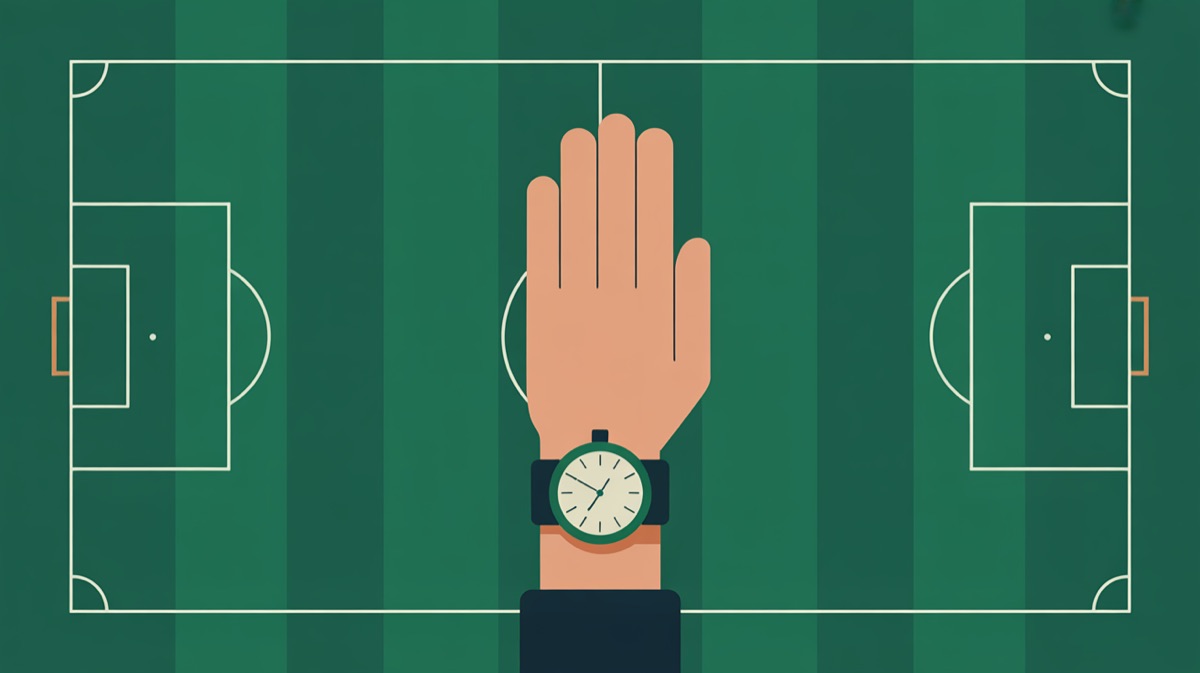
A regulation soccer game is 90 minutes long: two 45-minute halves with a 15-minute halftime between them. But the clock runs continuously and referees add stoppage time to the end of each half, so the real answer — kickoff to final whistle — is about two hours.
That 90 minutes is measured on a running clock. It counts up, it never stops — not for injuries, substitutions, or a ball kicked into the stands — and the referee's watch, not the stadium clock, decides when the match ends.
Here is how the time breaks down at every level, and why "ninety minutes" is both exactly right and slightly misleading.
A regulation match is 90 minutes on the clock — start the free 90-minute timer and see how a full game actually feels.
Open 90 Minute Timer →The Official Answer: Two 45-Minute Halves
Match duration is set by Law 7 of the Laws of the Game: two equal halves of 45 minutes, with a halftime interval of no more than 15. Every senior competition plays the same 90 — MLS, the Premier League, La Liga, the World Cup. There is no long version and no short version at the senior level.
| Segment | Duration |
|---|---|
| First half | 45 minutes |
| Halftime | 15 minutes |
| Second half | 45 minutes |
| Stoppage time (both halves combined) | 3–12 minutes |
| Typical total, kickoff to final whistle | 1 hr 50 min – 2 hr (longer with heavy stoppage) |
A match that kicks off at 3:00 usually ends just before 5:00. Broadcasters block two and a half hours to be safe. The 15-minute halftime is part of the schedule but not part of the game, which is why "a 90-minute match" and "a two-hour match" are both accurate descriptions of the same event.
Why the Clock Counts Up and Never Stops
Soccer runs time in the opposite direction from American sports. NFL and NBA clocks count down and freeze constantly — for incompletions, fouls, timeouts, reviews. Soccer's clock starts at 0:00, counts up, and stops for nothing, including goals. There are no TV timeouts and no two-minute drill; the only scheduled break is halftime.
The practical difference is large. An NFL game contains 60 minutes of clock and takes more than three hours to play. A soccer match contains 90 and is done in about two.
The official time lives on the referee's watch. The stadium clock is a courtesy, which is why it keeps ticking past 45:00 and 90:00 while play continues. MLS experimented with an American-style countdown clock in its early seasons and dropped it after the 1999 season to match the rest of the world.
It also changes how the end of a game feels. There is no scramble to stop the clock and no kneel-down; a team protecting a lead just has to survive whatever number goes up on the board.
Stoppage Time: Where the Extra Minutes Come From
Because the clock never stops, time lost to substitutions, injuries, goal celebrations, VAR reviews, and deliberate time-wasting has to be paid back. The referee tallies it during play and adds it to the end of each half. That is the number the fourth official raises on the board — and it is a minimum, not a limit.
Typical stoppage is 1–3 minutes in the first half and 3–6 in the second, where substitutions and late drama pile up. The 2022 World Cup reset expectations: FIFA told referees to account for lost time in full, and halves with 8–10 added minutes became routine. England's opener against Iran had more than 24 minutes of stoppage across the two halves.
If you are timing a match yourself, this is the part you cannot predict: the 90 minutes are fixed, but the stoppage is the referee's call, announced in the moment.
Extra Time and Penalties in Knockout Games
League matches can end in a draw. Knockout matches cannot, so a game level after 90 minutes goes to extra time: two additional 15-minute halves, with a short break between them. There is no sudden-death goal anymore — the golden-goal experiment was scrapped in 2004 — so both extra-time periods are always played in full. Still tied after 120? Penalty shootout.
| Format | Playing time | Real elapsed time |
|---|---|---|
| League or group-stage match | 90 min + stoppage | ~2 hours |
| Knockout, decided in extra time | 120 min + stoppage | ~2 hr 35 min |
| Knockout, decided on penalties | 120 min + shootout | ~2 hr 45 min |
This is why a cup final is a different commitment than a Tuesday league game. The 2022 World Cup final between Argentina and France went the full distance — extra time, then penalties — and ran well past the two-and-a-half-hour mark.
Soccer Game Length by Age and Level
Youth soccer scales the match down: shorter halves, a shorter halftime (usually 10 minutes), and very little stoppage, since referees at that level rarely add more than a minute.
| Level | Half length | Total playing time |
|---|---|---|
| U9–U10 | 25 minutes | 50 minutes |
| U11–U12 | 30 minutes | 60 minutes |
| U13–U14 | 35 minutes | 70 minutes |
| High school | 40 minutes | 80 minutes |
| College, adult amateur, professional | 45 minutes | 90 minutes |
A U10 game fits comfortably inside an hour, and a high school match inside 90 real minutes. Once players graduate to full 45-minute halves, the two-hour estimate applies. These are the common US standards; some leagues and tournaments shave five minutes in either direction, so check your club's rules for the exact number.
How Much Time to Block Off
Working numbers, based on the ranges above:
- League match on TV: 2 hours 15 minutes covers kickoff to final whistle with room to spare.
- Knockout match that could go to penalties: block a full 3 hours.
- Attending in person: add 30–45 minutes on each side for getting in and out of the ground.
- Youth game: the table above plus about 15 minutes for halftime and stragglers.
And if you want to feel what a regulation match actually is, start a 90-minute timer at kickoff. When it rings, the players will still be on the field — the 15-minute halftime and the referee's added minutes mean roughly 20 more minutes of play before the final whistle.
Frequently asked questions
How long is halftime in soccer?
Fifteen minutes at the professional level — Law 7 caps the interval there, and it can be changed only with the referee's permission. Youth leagues usually cut it to 5–10 minutes. Halftime is the one predictable pause in soccer: fixed, scheduled, and identical in every senior league from MLS to the Premier League.
Is stoppage time the same as extra time?
No, and the two get confused constantly. Stoppage time (also called added or injury time) is the handful of minutes the referee tacks onto the end of each half to repay time lost during play. Extra time is a separate 30-minute period — two 15-minute halves — played only in knockout matches that are tied after 90 minutes. Every match has stoppage time; only tied knockout games get extra time.
Can a soccer game end in a tie?
In league play, yes. If the score is level after 90 minutes plus stoppage, the match ends as a draw and each team takes one point. Roughly a quarter of professional league matches finish that way. Ties are only broken — with extra time, then penalties — in knockout competitions where one team has to advance.
How long is a college soccer game?
NCAA matches use the same two 45-minute halves as the pros, but the clock counts down and can be stopped by the referee, so there is no stoppage time. Since a 2022 rule change, regular-season games tied after 90 minutes simply end as draws; overtime only appears in postseason play.
How long is a World Cup soccer game?
The same 90 minutes as any professional match, but recent tournaments run long. In 2022, FIFA instructed referees to account fully for lost time, and halves with 8–10 added minutes pushed many matches well past the two-hour mark. Knockout-round games can reach roughly 2 hours 45 minutes if they go through extra time to a penalty shootout, as the 2022 final did.
A regulation match is 90 minutes on the clock — start the free 90-minute timer and see how a full game actually feels.
Open 90 Minute Timer →